
martedì 4 maggio 2010

Lhasa has own radio station

The Lhasa People's Radio Station began broadcasting Saturday, the first people's radio station for the capital of the Tibet autonomous region launched with the help from Jiangsu Province .
Programs of the newly established station will be broadcast in Tibetan and Mandarin on FM 91.4, covering Lhasa's urban areas as well as its seven counties and one district. Broadcasting on a daily basis from 7:50 am to 10:10 pm, the station will provide 10 programs including news, life services, healthcare information and entertainment.
Source: China Daily, Renminribao
lunedì 3 maggio 2010
The Desktop of a “Great Firewall Climber”
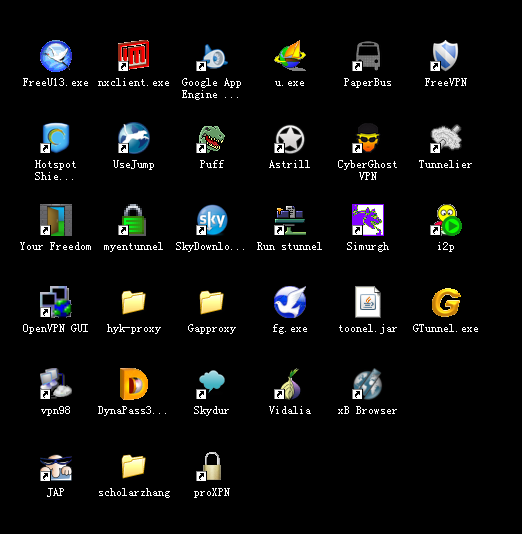
With the recent massive migration of “Google Dove“, ”Climbing the Wall” has become a growing sport among Chinese netizens. While there is no single silver bullet which offers the ultimate solution for circumventing the Great FIrewall, there are dozens of tools which can do the job. A really geeky and determined “Wall Climber” needs more than just a few back-up tools to accomplish his/her mission, since the Great Firewall is still quite capable of upgrading itself for more efficient blocking, including blocking many of those tools. So the Wall and “Climbing the Wall” is a cat-and-mouse arms race. This screenshot, entitled “Desktop of a Wall Climber,” is currently making the rounds in Chinese cyberspace and gives us an idea of what an obssessed “Wall Climber’s” desktop looks like.
Source: China Digital Times
domenica 2 maggio 2010
Cuochi italiani alla conquista d'Oriente - Italian chefs are invading far east countries
Marco and Carlo Sacco are launching new project in the East. With the help of a chinese business associate they opened a refined café. Just to prove the fact Italian chefs can be also managers.
Fonte: L'Espresso Food & Wine
sabato 24 aprile 2010
Parution livre - Fabula.org
212 p.
Prix : 21EUR
EAN : 9782296118195
Présentation de l'éditeur :
Le chemin de fer a eu un role majeur dans la vie des individus et de la société française et européenne à partir du XIXe siècle.
La diffusion du rail porte en soi un changement radical des rythmes de l'existence dès 1840 et jusqu'aux années 1930. Les oeuvres littéraires, spécifiquement en France et en Italie, témoignent, chez les premiers voyageurs, des réactions d'enthousiasme et de crainte qui s'expriment souvent par des métaphores animales. La locomotive est alors un monstre frénétique qui dévore les espaces, incarnant le triomphe de la science et la destruction du vieux monde calme et immobile. C'est l'instabilité, due à une nouvelle relation entre temps et espace, qui trouble les consciences des passagers. Les voyageurs du rail entre XIXe et XXe siècle sont confrontés à des relations occasionnelles et fuyantes avec leurs compagnons de route, ainsi qu'à des images aperçues par la fenêtre, déformées par la vitesse et englouties par la course du train. Ils ont, par conséquent, tendance à se réfugier en eux-mêmes, refusant tout contact avec l'extérieur, et se forgeant un paysage individuel, constitué des angoisses et des états d'âme qui les hantent pendant le voyage, et les mènent vers l'évasion et l'abstraction fantastique, parfois même jusqu'au seuil de la folie.
venerdì 23 aprile 2010
SUR LES RAILS
 La littérature de voyage
De la réalité aux profondeurs de l'âme
Le chemin de fer a eu un rôle majeur dans la vie des individus et de la société française et européenne à partir du XIXème siècle. Les oeuvres littéraires, spécifiquement en France et en Italie, témoignent des réact...ions d'enthousiasme et de crainte des premiers voyageurs. Confrontés à des relations occasionnelles et fuyantes avec leurs compagnons de route, ils ont tendance à se réfugier en eux-mêmes, et se forgent un paysage individuel qui les mène vers l'évasion et l'abstraction fantastique, parfois même au seuil de la folie.
Auteur - Tommaso Meldolesi
Editions L'Harmattan
venerdì 20 marzo 2009
BELGIUM: ACEA bemoans 'devastating' crisis
The economic recession and financial crisis have a 'devastating' effect on the automotive industry with serious implications for the wider economy, according to a report by Global Insight commissioned by the European Parliament and seized on by carmakers' association, ACEA.
ACEA says that the current crisis is threefold in nature: financial, economic and structural:
Financial: a drastically limited access to credit; and high costs of credits if available, both for the manufactures, their suppliers and for potential buyers of cars and trucks;
Economic: a dramatic drop in demand for both passenger cars and commercial vehicles;
Structural: low margins due to an increasingly complex and diverse product portfolio; and an increasingly pressing demand to adapt manufacturing, logistics, vehicles and R&D to meet environmental needs
The report says the automotive industry is the 'engine' of the European economy: around one in ten jobs in Europe depend directly or indirectly on the automotive sector; the industry is the largest investor in innovation and R&D and a formidable export force.
Lower levels of automotive manufacturing in Europe have a large spiraling effect on the wider economy because of the thousands of small and medium sized companies involved in the supply chain, vehicle sales and after-sales services, the report says.
The relative overcapacity in the industry, though often cited, is not a reason for the troubles that auto manufacturers are currently facing, ACEA maintains.
The cause of the current crisis is the unprecedented credit crunch and the rapid deterioration of all key automotive markets, the report says.
The report goes on to say that 'it is most essential' that EU governments and institutions ensure access to liquidity, through the European Investment Bank and in other ways.
It's vital that governments stimulate demand for new vehicles with fleet renewal schemes: this will benefit both the economy and the environment, ACEA says.